Cash Games
A continuation bet is an argument, and dry boards make it easy to win
The bet that follows a raise is only as strong as the board it is made on. Texture, not the cards in hand, decides whether the story holds together.
Poker News Strategy
Cash games, tournaments and the arithmetic behind them
Acting last is worth more than any starting hand, because it turns two guesses into one and lets the same cards be played for a wider profit.
Every other advantage in poker has to be earned. Cards are dealt at random, opponents choose their own style, and the size of the pot is the product of decisions nobody controls alone. Position is different. It is assigned by the movement of the dealer button, it rotates on a fixed schedule, and for one hand in every orbit it hands a player the last word on all three streets after the flop. Nothing else at the table is given away so cheaply or wasted so often.
The concrete benefit is informational. A player who acts first has to commit to a bet, a check or a fold without knowing what the other player intends to do. A player who acts last has already watched that decision happen. The same holding, played from the same stack, against the same opponent, is worth measurably more when it is played with that extra piece of information attached to every street.
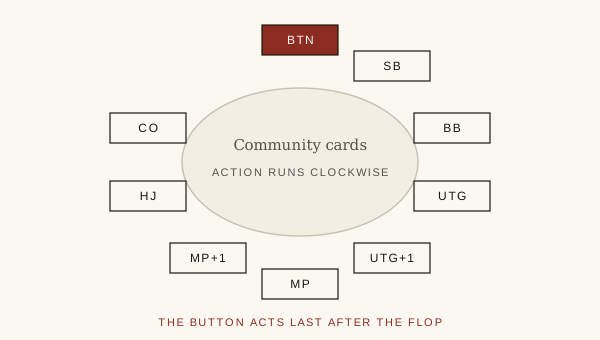
The second benefit is control of the size of the pot. When the player in position checks behind, the pot stops growing and the hand moves to a cheaper street. When the player in position bets, the pot grows on terms that player chose. The player out of position has neither of those levers cleanly available: a check invites a bet, and a bet invites a raise. Over a long session, that difference in control is what separates a marginal hand that can be played for value from a marginal hand that has to be abandoned.
Suited connectors, small pairs and the weaker broadway holdings are all hands that need to see a flop cheaply and then be able to give up cheaply. Both halves of that requirement are easier to satisfy when acting last. A small pair that misses the flop can be folded to a single bet without a second decision. The same pair, played from an early seat, has to survive being checked to, bet into and raised, all without knowing what anyone else holds.
This is the practical reason a starting-hand selection widens as the button approaches. It is not that the cards improve. It is that the cost of a mistake made with those cards falls, because the last decision on every street belongs to the player holding them.
The first error is playing a wide range from early seats because it worked on the button. The seat, not the hand, was carrying the profit. The second is checking behind automatically in position with anything short of a strong made hand, which throws away the very control the seat provides. The third, and the most expensive, is calling raises out of position with hands whose value depends entirely on seeing what the opponent does first.
A useful discipline is to make position an explicit part of the decision rather than an afterthought. Before calling from an early seat, ask whether the hand would still be worth playing if the same call had to be made with every street decided blind. If the answer is no, the hand was being played on borrowed value that the seat never supplied.
Position is decided by who is still in the hand, not by the button in isolation. A player one seat off the button is last to act as soon as the button folds, and a player in the blinds is last to act in a hand contested only between the blinds. Reading the seat correctly means counting live players, not counting seats. In a hand that has already been narrowed to two players, whoever is closer to the button on the clockwise circuit acts last on every street that follows.