Odds & Maths
Pot odds, and the one division that settles most calls
A call is worth making when the chance of winning is greater than the share of the final pot the call has to pay. Everything else is detail.
Poker News Strategy
Cash games, tournaments and the arithmetic behind them
The number of cards that improve a hand and the number that win it are rarely the same, and the gap between them is where money leaks.
Counting outs is the first piece of arithmetic most players learn and the one most often applied without revision. The count itself is mechanical. Thirteen cards of each suit exist, four ranks of each card exist, and anything already visible is subtracted. The difficulty is not arithmetic. It is deciding which of the cards being counted would actually leave the hand in front at showdown.
Four cards of a suit means nine remain, so a flush draw after the flop has nine outs. Four cards to a straight open at both ends means eight cards complete it. A straight missing one interior rank has four. An unpaired hand holding two cards higher than every card on the board has six cards that would pair it. A pair holding two cards to make three of a kind has two.
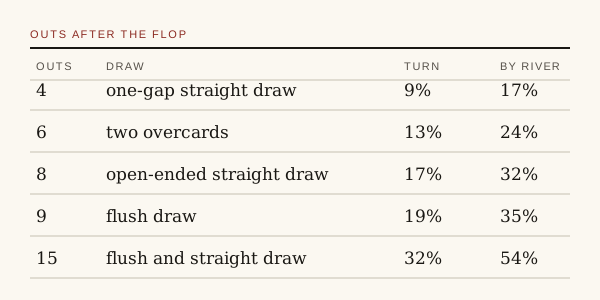
Draws combine, and combined draws are the ones worth playing hardest. A hand that holds both a flush draw and an open-ended straight draw has fifteen distinct cards that improve it, once the two cards counted twice are removed. That is a hand that is often close to even against a made hand, which is a very different proposition from either draw alone.
An out that completes a hand which is still second best is not an out. Three cases account for most of them. A straight completed by a card that puts a third suit on the board may lose to a flush. A flush completed on a paired board may lose to a full house. And a hand improved by pairing a card already on the board improves the opponent's hand at the same time.
The correction is not to guess at percentages but to name the hands that beat the improved holding and ask how plausible they are given the betting so far. If an opponent has raised twice on a board that already contains a pair, the outs that make a flush are worth fewer than nine, and it is better to count them as fewer than to count them as nine and be surprised.
The habit of counting a draw across both the turn and the river assumes both cards will be seen for the price currently being asked. That assumption only holds when the caller is committed, or when the opponent will not bet again. If another bet is coming on the turn, the correct comparison on the flop uses the chance of hitting on the next card alone, at the price being asked right now.
Applied consistently, the distinction removes a whole class of losing calls: the flop call made on the strength of a two-card chance, followed by a turn fold that leaves the earlier call paying for a card it never bought.