Tournaments
What the bubble does to the value of a chip
In a tournament, chips won are worth less than chips lost. Near the money that gap widens far enough to change which hands are worth playing.
Poker News Strategy
Cash games, tournaments and the arithmetic behind them
Below a certain depth, a raise that is not a commitment is just a smaller loss. The threshold is set by the blinds, not by the cards.
Stack depth in a tournament is measured in big blinds rather than in chips, because the blind level rather than the chip count decides what a stack can still do. A stack that could contest three streets an hour ago may only be able to contest one now, without a single chip having changed hands.
Deep, a raise is the opening move of a hand that will be played over several streets. There is room to bet the flop, room to give up, room to be raised and still fold, and room for the eventual pot to be several times the opening raise. All of the usual post-flop skills apply, because there is enough behind for them to matter.
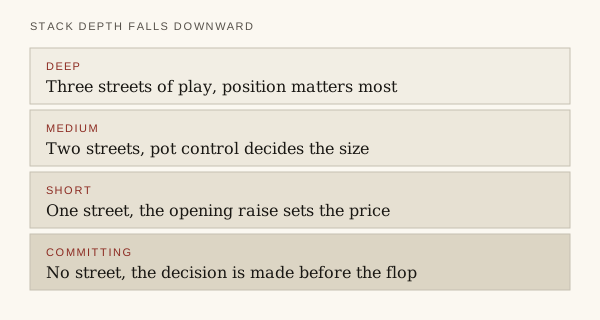
Short, none of that is true. A raise that leaves barely more than the raise itself behind cannot be folded to a re-raise without conceding most of a stack, and it cannot support a meaningful bet on any later street. The hand is effectively decided before the flop whether or not the player intended it to be. At that point a raise that keeps chips back is not a smaller commitment; it is the same commitment made for less money.
There is no single depth that applies at every table, because the threshold moves with the number of players still to act, the size of the antes, and how willing the remaining stacks are to call. What is stable is the reasoning: the threshold arrives when the stack can no longer profitably fold to a re-raise after opening. Once folding to pressure costs most of the stack anyway, the fold has already been priced out of the hand, and the only two honest options left are to commit or to pass.
Two consequences follow. The first is that the range of hands worth committing widens as depth falls, because the value of the blinds and antes grows relative to the stack. The second is that hands whose value is concentrated in post-flop play, such as small pairs and suited connectors, lose value faster than hands whose value is immediate, such as the higher unpaired broadway cards and any ace.
From the other side, the decision is a price question and nothing else. A stack that has committed is offering a fixed price to call, and the only thing that matters is whether the calling hand is far enough ahead of the committing range to justify it. The size of the pot before the commitment, which includes the blinds and every ante, is part of that price and is routinely underweighted.
The error to avoid is treating a short stack's commitment as automatically weak. A stack short enough to be committing is choosing from a wider range than it would use deep, but the wider range still contains every strong hand, and the price of being wrong is a large fraction of the caller's own stack.